
 0
 0
A fashion designer creates clothing, accessories, and footwear, and the salary for that work lands, on average, at a median of $80,960 a year as of May 2025. That’s the number to anchor on. The full picture is wider than one figure, though. In May 2023, the lowest-paid tenth of designers earned $37,090 or less, while the top tenth earned $160,850 or more.
Why such a gap? Pay depends on where a designer works, how much experience they bring, and what kind of design they do. A designer sketching for a small studio and one leading a collection at an established label live in very different financial worlds.
This guide breaks down what designers earn at each level, what pushes pay up or down, and how to read the numbers honestly. We’ll also look at how the shift toward more ethical, sustainable fashion connects to the field, because the people shaping what we wear are also shaping how it’s made. Understanding the money is the first step to understanding the career.
What a Fashion Designer Salary Actually Means
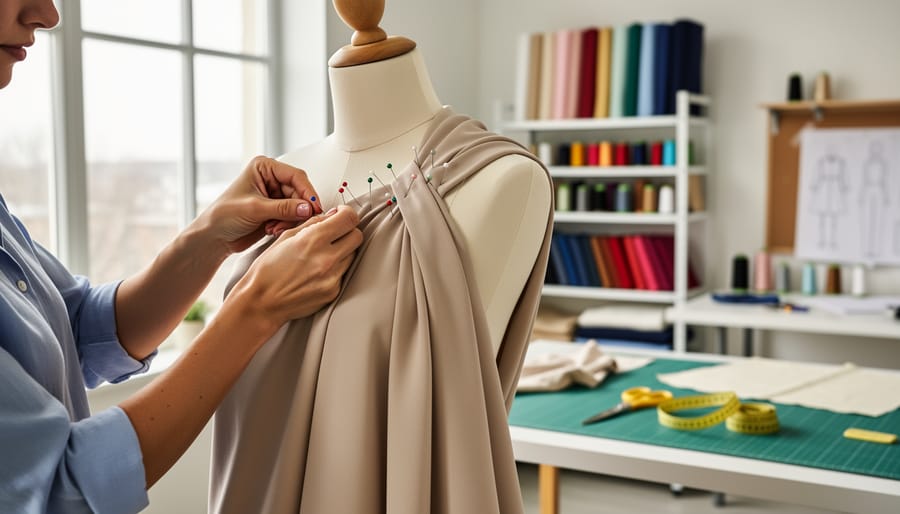
A fashion designer salary is simply the annual wage paid to someone who creates clothing, accessories, and footwear for a living. That covers a lot of ground. On any given day, a designer might sketch new ideas, choose fabrics and trims, work out how a garment will be constructed, and refine a piece until it fits and functions the way it should.
The numbers you’ll see throughout this article come with a few terms worth knowing up front, because reading them the wrong way can leave you with a skewed picture of what designers actually earn.
- Fashion designer
- A professional who creates clothing, accessories, and footwear, from first concept through to the finished design.
- Median annual wage
- The midpoint of all wages in a group. Half of workers earn more than this figure, and half earn less.
- Percentile
- A way of showing where a wage sits within the full spread. The 10th percentile means 10 percent of workers earn less than that amount.
- Wage range
- The distance between the lowest and highest earners in a group, which shows how much pay varies within a field.
The distinction between a median and an average matters more than it might seem. An average adds up every wage and divides by the number of people, so a handful of very high earners can pull it upward and make typical pay look better than it is. A median avoids that problem by finding the middle. That’s why we focus on medians here: they give you a more honest sense of what a designer in the middle of the pack actually takes home.
How Much Do Fashion Designers Make? The Verified Numbers
Reading the Range: What the Low and High Ends Tell You
The gap between the bottom and top of the range is the story here. In May 2023, the 10th percentile wage was $37,090, while the 90th percentile reached $160,850. That means one in ten fashion designers earned less than the first figure, and one in ten earned more than the second. The distance between them is enormous, which tells you this is not a field with one standard paycheck.
It also helps to remember what a median actually is. It marks the midpoint, where half of designers earn more and half earn less. It is a useful reference point, but it is not a promise of what any individual will make. The data shows how wide the spread is, not why any one designer lands where they do.
What Shapes a Designer’s Pay

A designer’s paycheck isn’t set by the job title alone. It’s the result of several forces working together, which helps explain why the verified wage data shows such a wide spread between the lowest and highest earners. One caveat up front: the figures we have don’t break pay out by any of the factors below, so this discussion is directional rather than numeric. Think of it as a map of what tends to matter, not a price list.
Here are the main factors that commonly move pay in design careers:
- Experience level: designers who have shipped more collections generally take on more responsibility and negotiating power.
- Type of employer: a large company, a small independent label, and self-employment each handle budgets, benefits, and income stability very differently.
- Product category: clothing, accessories, and footwear involve different skills, production demands, and market economics.
- Scope of the role: leading a design team or owning a whole line carries different expectations than supporting one part of the process.
These factors rarely act alone. A seasoned designer at a small label might earn differently from a mid-career colleague at a large company, and a freelancer’s income can swing from one season to the next in ways a salaried role doesn’t. That interplay is exactly why one median can’t tell you what any single designer should expect.
For readers who care about ethical fashion, this is a useful reminder. Behind every garment is a person whose pay depends on the structure of the business they work for. Asking how a brand supports its design team, not just how it sources its fabric, is part of looking at the whole picture honestly.
Where Sustainability Fits Into the Salary Conversation
Pay is only one part of what makes clothing ethical, but it’s a part we rarely talk about. When we ask whether a brand is sustainable, we usually look at fabrics and factories. Fewer of us ask about the people who dream up the designs in the first place.
Conscious design work is becoming a bigger part of the profession’s future. Designers who plan for durability, choose lower-impact materials, and shape production to cut waste are making decisions that echo through a garment’s whole life. That kind of thinking sits at the heart of slow fashion, where fewer, better-made pieces replace the endless churn of disposable trends. It also depends on skill, patience, and time, all of which deserve fair compensation.
We can’t say whether sustainability-focused roles pay more or less than other design jobs, because the verified data doesn’t break pay out that way, and guessing would only add to the vague claims we try to avoid. What we can say is that a design career is a real livelihood, and the figures in this article show how wide the range of earnings can be.
So how should you, as a shopper, think about it? Look for brands that are open about their people as well as their materials. A company proud of its sustainable craftsmanship should be able to tell you who makes its clothes and how those makers are valued. Asking that question is a small, hopeful act, and it nudges the whole industry toward greater transparency.
How People Become Fashion Designers
Becoming a fashion designer is less a single path than a set of skills built over time. Most designers develop four core areas: sketching, so ideas can be communicated clearly; pattern and construction knowledge, so a drawing can become a garment that actually fits and holds together; an understanding of materials, including how fabrics drape, wear, and age; and a portfolio that shows how they think, not just what they can draw.
Routes in vary. Some people study design formally, others learn through apprenticeships, entry-level studio roles, or by making and selling their own pieces. None of these is the “right” one. What tends to matter is whether you can show real work and keep improving it.
Hands-on experience carries a lot of weight. Cutting, sewing, fitting, and fixing mistakes teaches things a sketchbook can’t, and it gives you the vocabulary to work with pattern makers, factories, and suppliers. That practical fluency is also where sustainability becomes concrete, since choices about fabric, durability, and waste are made at the design stage. If you want to see how those choices play out in practice, look at how ethical fashion brands approach their work.
This matters for the money question because a designer’s earning path rarely stays flat. As skills deepen and a body of work grows, responsibilities usually widen. That helps explain why the pay data covers such a broad range, from modest entry-level wages to the high end of the field.
Fashion Designer Salary: Common Questions
How much do fashion designers make?
The median annual wage for fashion designers was $80,960 in May 2025. That’s a midpoint, so half of designers earned more and half earned less.
What do fashion designers do?
They create clothing, accessories, and footwear. That covers everything from early sketches to the finished product.
How do you become a fashion designer?
Most people build skills in sketching, pattern and construction knowledge, and materials, then put their best work into a portfolio. Hands-on experience matters as much as any single route into the field.
Is the salary the same everywhere?
No. In May 2023, the 10th percentile wage was $37,090, while the 90th percentile reached $160,850. Pay varies widely across the field.
Think of these figures as a starting point, not a promise. Looking at the median and the full range together gives you a far more honest picture than any single number could.
The median annual wage for fashion designers was $80,960 in May 2025, but that single number only tells part of the story. Pay in this field stretches across a wide range, which is a good reminder that no one figure captures every designer’s reality.
Still, the numbers matter. When we know what designers actually earn, we start to see the real people behind the clothes we buy: the sketching, the fittings, the countless small decisions. That kind of clarity is what makes conscious choices possible. Keep asking questions, keep valuing transparency, and keep supporting a fashion world that treats its people well.



Average Rating